


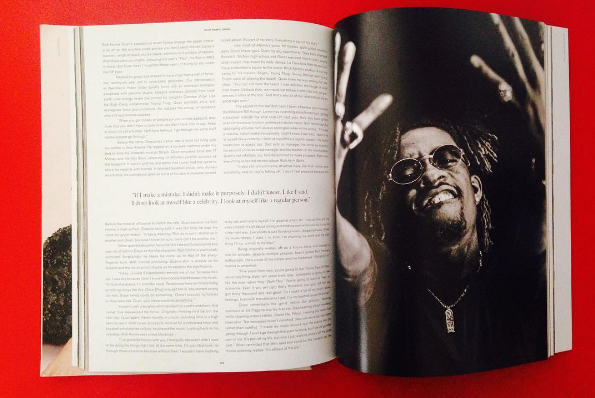
Gunplay Interview
Gunplay is volatile, likeable and mildly insane. He’s also a hell of a rapper. Among his polished MMG label mates, Gunplay is the half Puerto Rican, half Jamaican wildcard, rapping like he’s throwing evidence out of the car mid-chase. And sometimes he just might be. The stories of Richard Morales Jr. are the stuff of rap legend and often eclipse the music. Gunplay robbed his accountant at gunpoint. Gunplay’s been knocked out twice on camera. Gunplay loves cocaine and fishing. Like his precursor ODB, the mythos of Morales is unparalleled.
When Gunplay told reporters between sniffs that he could quit coke any time he wanted, no one believed him. After all, this guy publicly admitted to spending £1500 a week and was filmed traveling to Columbia just to partake in the purest China White he could find. But so far, he’s kept his word. Gunplay assures me multiple times during our interview that his focus is now entirely on his career. Wrongly perceived as a Rick Ross weed carrier, he sprung into profile after the collapse of their group Triple C’s in 2009. On the strength of potent guest verses and unrestrained mixtapes, Gunplay signed a solo deal three years later with Def Jam. That same year, his aforementioned bookkeeper robbery case almost derailed any chance of a career as Morales faced life in prison. Gunplay narrowly avoided the charge due to the witness refusing to testify and has spent the last few years rebuilding his momentum.
With the long delayed release of his debut album Living Legend set for the end of the month, I spoke to the determined Miamian about his new outlook. Like Gunplay’s persona, the interview was unpredictable with his phone line and concentration frequently dropping out as he shopped with his girl for $300 Chanel perfume. We chatted about the time Gunplay pulled Rick Ross from a car wreckage, the longest he’s gone without sleeping and learning to write while sober. He also rapped for me, recalled seeing Biggie live and discussed why fans still love him.
Young Thug - I Need Chickens
If Thugga continues to spit, mumble, and stutter artful raps at this pace, the staff at Passionweiss might get twin lip piercings to celebrate. With “I Need Chickens,” Young Thug throws out his second freely inventive single alongside Mike Will Made It in four days. Much to the annoyance of the U.S Marshals Office and Conservative Rap Coalition, the persistent rise of the skinny jeaned martian continues.
Young Thug doesn’t need extended metaphors and multi-syllabic wordplay; he barely needs English. The tropes might not change, but the vibe is on a thousand. For a joyous three minutes, Jeffrey Williams harmonizes with himself, ad-libs bird calls and slings a few rhymes about moolah. Being near incomprehensible doesn’t make it any less vital. This is music for distorting how you think rap should sound. What Thugga does in five words is more exciting than what many rappers do with an entire song.
Meek Mill - Check
Human megaphone Meek Mill takes a break from sobbing like a broken-up boss to offer more adrenaline in MP3 form. “Check” is Meek’s fifth single from Dreams Worth More Than Money and if you’ve been counting, his fiftieth “I’m a Boss” sequel. The thin-voiced rat-a-tat is more music for extreme sports, face-punching and seven figure bank deposits. Essentially, it’s the same as last year’s “FYM” only this time without a hungry Boosie verse. “Check” is a formulaic hustlers ode for those with an insatiable thirst for thumping drums, menacing pianos and minimal ambition. Meek and his cohorts are in the building, counting money and some other stuff he’s told you about before. But it doesn’t matter, Meek Mill is the human Monster Energy Drink. I can’t take it in large doses, but he’s not about to put you to sleep. (Presumably).
Music Video Director Dave Meyers (Missy Elliot, Outkast, Jay Z etc)
Dave Meyers’ frenetic imagination has conjured some of this era’s most recognizable music videos. Active since the 90s, his resume consists of over 200 projects with a genre-spanning list of artists from Jay-Z to Mick Jagger.
A chance meeting with Good Will Hunting filmmaker Gus Van Sant inspired Meyers to pursue videos and he landed his first MTV slot in 1997 with underground Oakland duo The Whoridas. The Californian director’s most iconic work includes eleven of Missy Elliot’s career defining videos as well as visuals for Outkast’s “Bombs Over Baghdad” and “So Fresh, So Clean.” He won a best video Grammy Award in 2005 for Elliot’s “Lose Control” and has also received eleven MTV Awards.
Meyers recently took a three-year sabbatical to pursue film and advertising, but is now diving back into capturing music. During more than an hour of conversation, we discussed a fraction of his filmography and thoughts on industry issues such as lower budgets and product placement. He discussed early interactions with Kanye West, shooting with Nas, making 44 videos in one year and a whole lot more.
Do you think music videos have worth in 2015 or are they in danger of becoming content for content’s sake?
They certainly have regained value for me. I took a three or four year break there and focused on commercials. What I’ve learned with the reach of a music video, especially to it’s fans, is there’s nothing quite like it other than maybe Jurassic Park [laughs]. It’s a very strong connection that artists still maintain with their fans, even more so than ever, because of the way the Internet is. To be part of that and to be a creative entity associated with that is kind of the purpose of filmmaking, or my particular passion. I’ve reached out to all of the folks you’d expect me to reach out to and we’re brewing some cool stuff that is coming our way. You’ll hopefully see some collaboration later this year with Missy [Elliot], Janet [Jackson] and there are a variety of things that might be coming. My passion for videos is alive and well and as I think the artists have sort of gotten used to the lower budgets, the resulting climate is a push for creativity.